Architecture has always been a battle against translation.
An idea starts clean. A feeling. A space. A moment of light. A client's half-formed sentence. A designer's instinct that the room should feel warmer, calmer, heavier, lighter.
Then the idea enters the machine.
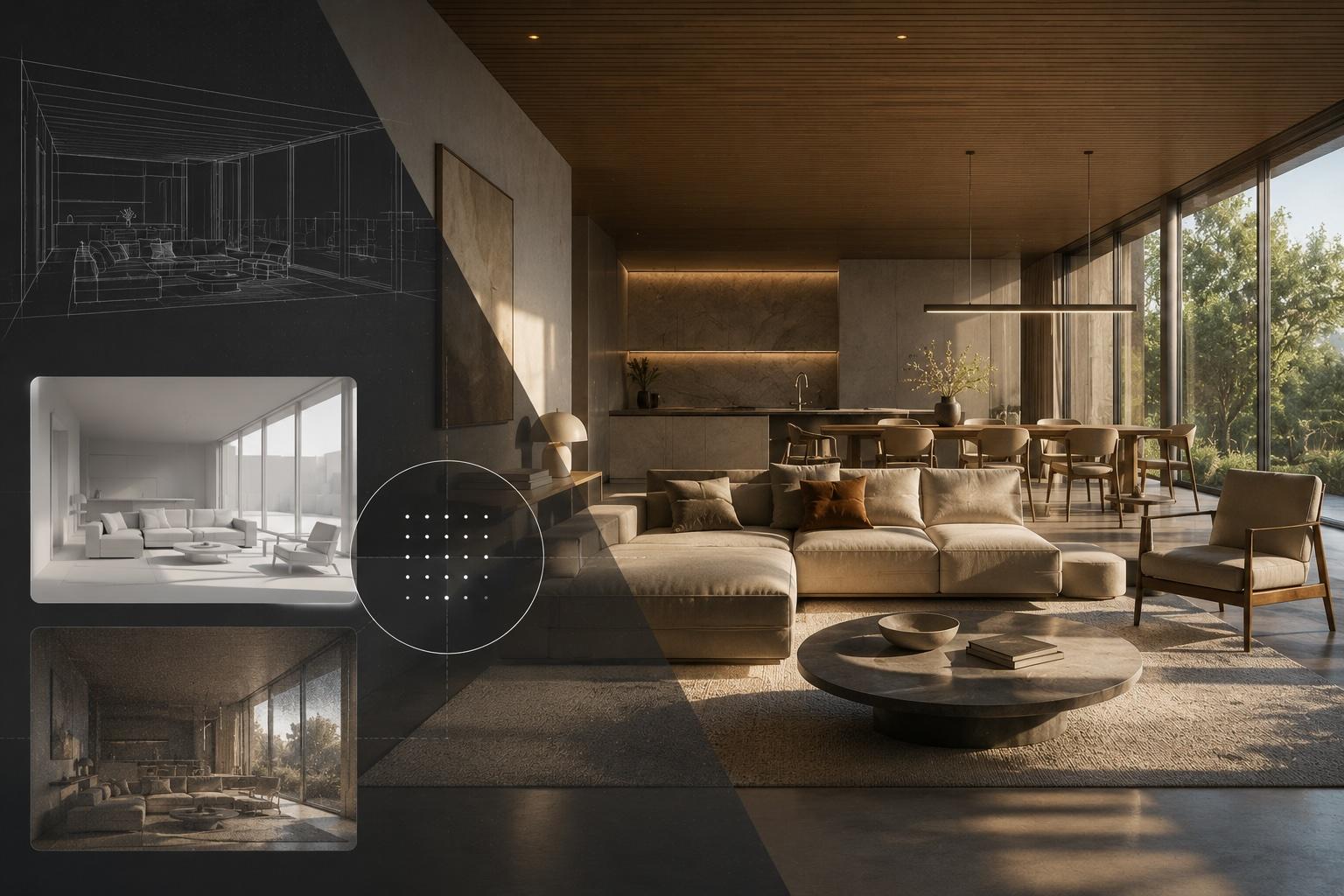
Sketch becomes model. Model becomes scene. Scene becomes render setup. Render setup becomes material pass. Material pass becomes revision. Revision becomes another queue.
Somewhere between the first instinct and the final image, the design loses oxygen. Not because architects lack imagination. Because visualization has historically been too slow to keep up with imagination.
That is what AI is changing. Not rendering. Not pretty images. Not the small debate of AI versus a render technician. The real question is: what happens when visual thinking becomes instant?
The Old Bottleneck Was Not Software
Architects already have software. Too much of it. CAD. BIM. SketchUp. Rhino. Revit. Enscape. Lumion. Corona. V-Ray. Photoshop. After Effects. Premiere.
The problem was never that architects lacked tools. The problem was that every tool added another translation layer. You had to stop thinking and start operating. You had to become technical at the exact moment you needed to stay creative.
That was the hidden cost of traditional architectural visualization. Not render time. Cognitive interruption.
The designer's mind works in loops: see, react, adjust, compare, decide. Traditional visualization works in chains: export, assign, light, render, wait, review, revise, repeat.
A chain is not a loop. A chain slows down thought. AI-native visualization collapses the chain into the loop.
AI Will Not Just Make ArchViz Faster
Speed is the obvious benefit. It is also the least interesting one.
Yes, AI can generate visuals faster. But the deeper shift is this: architectural visualization is moving from production to conversation.
In the old world, a render was a deliverable. In the new world, a render is a question.
What if the morning light was softer? What if the walnut became oak? What if the same space had a dusk version, a rainy version, a warmer retail version, a premium residential version? These questions used to be expensive. So they were not asked.
When questions are expensive, creativity becomes conservative. When questions become cheap, design becomes alive.
This is the mind-bending part: AI does not just accelerate decisions. It increases the number of decisions worth exploring. That changes the role of visualization entirely. It is no longer the final polish after design. It becomes part of design itself.
The First Wave Of AI Architecture Tools Was A Toy
The first wave made the industry curious. Upload an image. Type a prompt. Get a beautiful result. Sometimes.
The images were impressive. But architects noticed the problem quickly. The chair changed. The window moved. The ceiling height shifted. The material intent disappeared. The image looked good, but the design was no longer yours.
That is the difference between image generation and architectural visualization.
Architecture is not a moodboard. A building is a system of constraints. Geometry matters. Scale matters. Material continuity matters. Camera position matters. Client intent matters. Design authorship matters.
A generic AI platform can make a seductive image. But an architect does not need seduction. An architect needs control.
The New AI-Native Stack Is Emerging
We are now seeing a new category form. Not AI image tools for architects. AI-native design infrastructure. Different startups are attacking different parts of the architectural process.
Drafted AI
Drafted is exploring AI-generated house plans, with users able to generate home layouts in seconds and download PDF and CAD files. Its public site shows a large library of AI-created plans, pointing toward early residential concepting that becomes searchable, remixable, and instantly testable.
Illoca
Illoca is building around how architects already think: sketches, markups, references, conversations, and iteration. Its Tracing Paper direction is focused on controllability for professional practice and AI agents handling production work in the background.
Finch3D
Finch works at the building-design layer, helping teams generate building designs with precision, explore options at scale, use real-time data, encode design systems, and refine with AI support.
Vibe3D
Vibe3D is focused on the last mile between design intent and client understanding: turning SketchUp, Revit, 3ds Max, sketches, snapshots, and references into photorealistic renders and cinematic walkthroughs fast enough to stay inside the creative conversation.
These companies are not all doing the same thing. That is the point. The future of architecture AI will not be one magic button. It will be a new stack: concept, plan, model, visualize, iterate, present, sell.
The Real Competitive Edge Is Not AI
Everyone has AI now. That is no longer the edge. The edge is workflow depth.
Weak AI platforms ask:
What image do you want?
Strong AI-native platforms ask:
What decision are you trying to make?
That is the gap. Most AI tools are built for output. Architecture needs tools built for intent.
A client does not say:
Please generate a 16:9 photorealistic interior render with cinematic lighting and accurate material fidelity.
A client says:
Can this feel more premium?
A designer does not think:
I need a prompt.
A designer thinks:
This wall is too cold.
The flooring feels wrong.
The light should be softer.
The client needs to understand the space.
We need a walkthrough before tomorrow’s meeting.
The best AI tools will not make architects become prompt engineers. They will make AI disappear into the workflow.
Why Vibe3D Is Different From Generic AI Platforms
Generic platforms are optimized for imagination. Vibe3D is optimized for architectural intent.
The goal is not to create a random beautiful image. The goal is to preserve the original design, respect the model, understand material intent, and let architects change lighting & mood, edit renders, or create flythrough videos without rebuilding the entire visualization pipeline.
That is a different promise. Not upload anything and get something cool. Bring your design, keep control, and generate client-ready visualization fast enough to stay inside the creative conversation.
Novelty produces impressive one-offs. Infrastructure produces reliable loops. ArchViz AI will be judged by the loop.
Visualization Becomes A Thinking Medium
This is the part architects need to take seriously. AI visualization will not only change how projects are presented. It will change how they are designed.
Because when visualization is slow, it happens after decisions. When visualization is instant, it happens before decisions. That flips the process.
A designer can test five material palettes before committing. A studio can compare daylight moods before locking the scene. An interior designer can show three emotional directions in the first meeting. A developer can understand the sales story before the full marketing package is built. A small studio can pitch with the visual quality of a much larger team.
This is not just productivity. This is leverage. Better visualization creates better decisions. Better decisions create better design. Better design creates more trust. And trust wins projects.
The Client Meeting Will Change First
The most immediate change will happen in client communication. Today, many client meetings are limited by what has already been prepared. You show the images you had time to make. The client reacts. Then the actual creative conversation begins. But the meeting ends before the visual loop can continue.
AI changes that.
A client says the kitchen feels too dark. Instead of taking a note, updating the model later, exporting again, rendering again, and sending a revised image tomorrow, the designer tests a lighter material direction in the meeting.
The client asks for a warmer evening mood. The designer generates it. The client wonders how the space feels as a walkthrough. The designer creates a cinematic sequence. The conversation does not pause. The image keeps up.
That is not a faster render workflow. That is a different meeting.
The Best Designers Will Not Use AI To Do Less
They will use it to see more. More alternatives. More edge cases. More moods. More mistakes before construction. More alignment before approvals. More confidence before committing.
This is why the AI will replace render technicians framing is too small. Yes, some repetitive production work will shrink. But the bigger story is that architectural visualization will move upstream.
It will become part of ideation, client strategy, marketing, approvals, and storytelling. A render will no longer be the final image. It will be one frame in an evolving design conversation. A walkthrough will no longer be a luxury deliverable. It will become a normal way to understand space.
Why Architects And Interior Designers Need To Adapt AI Now
Most technological shifts look obvious in hindsight. But early on, they look like toys. The first AI renders looked like toys. Then they became moodboards. Then they became concept tools. Now they are becoming workflow tools. Next, they become infrastructure.
That is the moment to pay attention. Because once a tool becomes infrastructure, the competitive gap compounds.
The studio that can show three directions in one day will beat the studio that needs a week. The designer who can explore ten moods before the client call will make sharper recommendations. The interior designer who can turn sketches into convincing visuals instantly will sell ideas earlier. The architect who can generate a walkthrough before the project is fully presentation ready will communicate space better than the one waiting for the perfect pipeline.
The Future Of ArchViz Has Three Rules
1. Fidelity Beats Fantasy
The future does not belong to AI tools that invent beautiful but useless images. It belongs to tools that understand constraints. A beautiful render that changes the design is not a render. It is a hallucination with good lighting.
2. Iteration Beats Perfection
The old workflow rewarded the perfect final image. The new workflow rewards the fastest path to the right decision. The question is no longer:
How good is the first output?
The question is:
How quickly can I guide it to the exact design intent?
3. Workflow Beats Prompts
Prompting is not the future of architecture AI. Workflow is. Architects should not have to become linguists to control visuals. The best AI tools will feel less like chatbots and more like design instruments: upload, adjust, compare, relight, restyle, regenerate, animate, present.
The Bottom Line
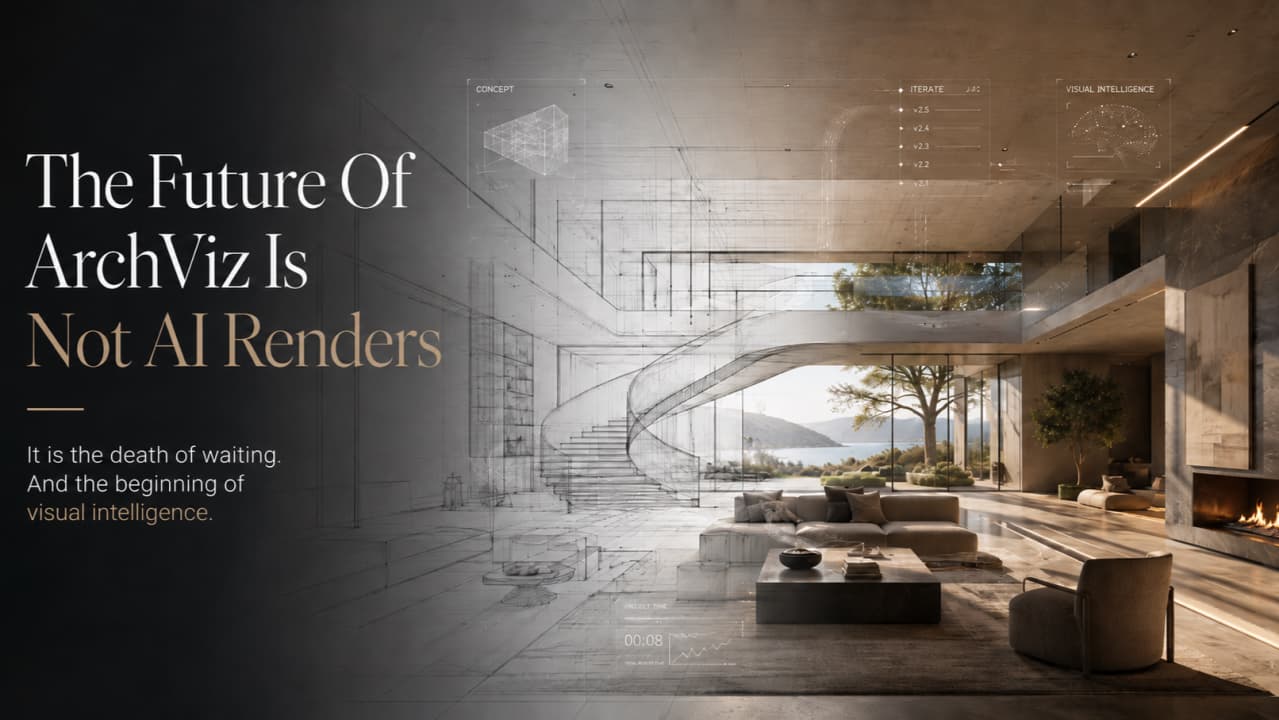
The future of architectural visualization is not AI versus traditional rendering. That debate is already outdated. The real future is visual intelligence embedded directly into the design process.
Explore how Vibe3D is collapsing the last mile between design intent and photorealistic visualization.
Architecture is moving from slow visual production to instant visual reasoning.
The render is no longer the end. It is the interface. The walkthrough is no longer a deliverable. It is a design language.
And the architect who understands this shift will not be replaced by AI. They will become harder to compete with. Because the future does not belong to the person with the best tool. It belongs to the person with the fastest loop between imagination and reality.