An architectural concept sheet is, in essence, the visual manifesto for a project. It’s where you take all those abstract ideas floating around in your head and translate them into a tangible, shareable document that everyone can get behind. Think of it as the crucial bridge connecting that first spark of inspiration to the nitty-gritty of technical design.
This single document is all about capturing the core narrative, atmosphere, and intent of a project. Its real job is to get clients and stakeholders excited and, most importantly, on the same page from day one.
The Strategic Role of a Concept Sheet
Don't mistake a concept sheet for just a collage of pretty pictures. It's a powerful strategic tool. Its whole purpose is to tell a compelling story about your design long before you even think about construction documents. This visual narrative is what ensures everyone involved—from your client to your engineering team—shares the same understanding of what you're trying to achieve.
A well-crafted sheet is your best defence against costly misunderstandings down the road. By establishing a clear, agreed-upon direction early on, you make the approval process smoother and build a solid foundation for the entire design journey. It’s the difference between a project that kicks off with absolute clarity and one that gets stuck in a frustrating loop of revisions because the vision wasn't nailed down from the start.
Why It’s a Non-Negotiable Document
In a professional setting, the concept sheet isn’t just good practice; it’s often a flat-out requirement. Take India's fast-paced urban development scene, for example. It has become an essential piece of design documentation.
Believe it or not, over 85% of registered architectural projects submitted for approval in cities like Mumbai and Delhi in the last five years included detailed concept sheets as part of the mandatory pre-design phase. To learn more about how Indian architectural standards are evolving, check out this guide on architectural sheet composition.
This reflects a broader trend: preliminary design documents are being given more weight to ensure projects are viable and coherent from the start. For more on crafting these foundational ideas, see our detailed guide on architectural design concepts.
A great architectural concept sheet doesn’t just show what a building will look like; it explains why it should exist. It articulates the problem, presents the vision, and justifies the design choices in a language that both designers and non-designers can instantly grasp.
Core Functions at a Glance
To really get a feel for why this document is so important, it helps to see its main jobs laid out. The table below breaks down the primary functions a concept sheet serves throughout a project's life.
Core Functions of an Architectural Concept Sheet
| Function | Description | Primary Audience |
|---|---|---|
| Vision Alignment | Ensures the client, architect, and all stakeholders share a single, unified understanding of the project's aesthetic and functional direction. | Client, Design Team, Stakeholders |
| Securing Buy-In | Acts as a persuasive pitch to get early approval and build enthusiasm from key decision-makers, providing confidence to move forward. | Client, Investors, Approval Boards |
| Guiding Design | Serves as a constant reference point for the design team, ensuring that later, more detailed drawings stay true to the original, approved concept. | Internal Design Team, Engineers |
| Clear Communication | Simplifies complex architectural ideas into an easily digestible visual format, cutting down on misunderstandings and lengthy explanations. | All Parties Involved |
Ultimately, a concept sheet is more than just a presentation—it's the foundational agreement that keeps the entire project grounded and headed in the right direction.
What Goes Into a Winning Concept Sheet?
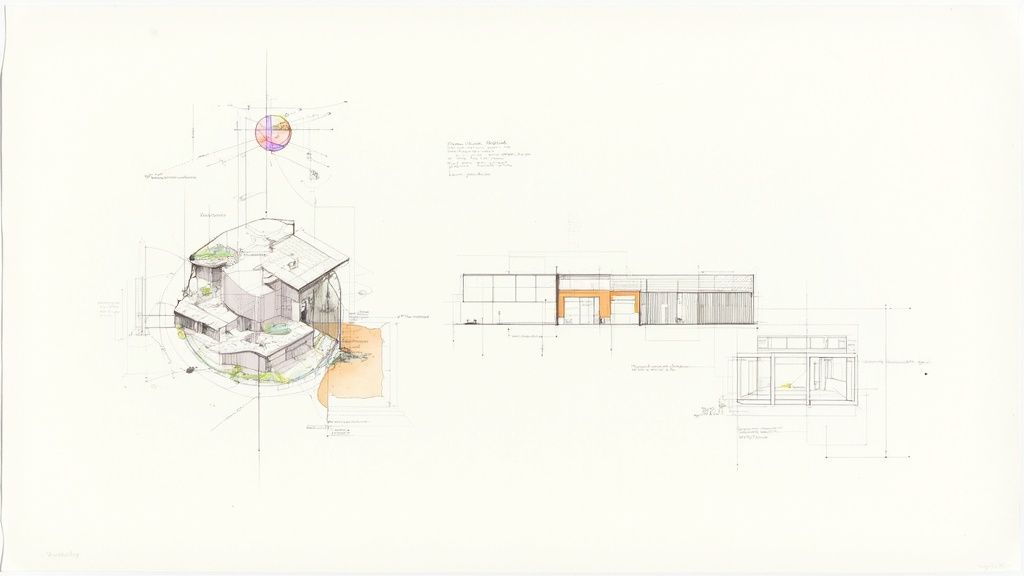
A great architectural concept sheet isn’t just a random collage of nice pictures. It's a visual argument. It’s a story. Every single element on that page has a job to do, working together to guide a client from the broad context of the project right down to the feel of the materials.
Think of it like cooking. You can have the best ingredients in the world, but if you don't combine them thoughtfully, you end up with a mess. Get it right, though, and you create something that's not only clear but genuinely persuasive.
Let's break down the core pieces that form the backbone of a concept sheet that actually works.
Setting the Scene: Site and Context Diagrams
Before you even think about showing your design, you have to prove you understand its home. This is where site and context diagrams come in. They are your chance to show—not just tell—the client you've done your homework. They ground your project in the real world and show that your design is a direct, intelligent response to its environment.
These aren't supposed to be technical site plans cluttered with dimensions. We're talking about clean, graphical representations that get straight to the point. Your diagrams should quickly communicate things like:
-
Sun Paths and Wind Patterns: How will the sun warm the building in winter? Where will you get natural ventilation from? Show it.
-
Key Views and Vistas: What are the money shots from the site? And how will the building be seen from key approach points?
-
Circulation Routes: How do people and cars get to and around the site? Where are the nearest bus stops or train stations?
-
The Neighbourhood Vibe: What’s going on next door? Are you surrounded by towering offices, quiet homes, or a bustling public park? Show the scale and character.
Nailing these diagrams makes your design decisions feel less like a whim and more like an inevitable, perfect fit.
The Big Idea: Conceptual Plans, Sections, and Massing
Okay, the stage is set. Now you can bring your design into the picture. But hold on—this isn't the time for detailed construction drawings. The aim here is to communicate the core idea, the fundamental spatial arrangement, in a way anyone can understand at a glance.
Conceptual plans and sections are all about flow and organisation. They should highlight the relationship between different spaces, how people will move through them, and the overall strategy. Think of them as storyboards for the experience of being in the building.
One of the biggest mistakes I see is cramming these early drawings with too much technical jargon. Keep the line work clean. Use minimal notes. You’re trying to sell the 'big idea,' not the wall construction details.
Massing studies are where the building starts to take three-dimensional form. Whether they’re quick hand sketches, foam models, or simple digital blocks, these studies explore the building's overall volume and presence on the site. This is your playground for testing different shapes and seeing how the building feels in its context before you get locked into a specific design. These early explorations are absolutely crucial for a strong final building. If you want to dive deeper into this initial creative phase, our guide on the design concept for architecture is a great next step.
Capturing the Vibe: Mood Boards and Material Palettes
If plans and diagrams are the logic of your design, the mood board is its soul. This is your chance to communicate the feeling you're trying to create—the atmosphere, texture, and overall sensory experience.
A good mood board is more than just a collection of other buildings you like. It's a carefully curated collage of images that evokes a specific emotion. Pull in textures from nature, snippets of art, photos of furniture, or even abstract colour fields that all point in the same direction.
The material palette makes this tangible. It’s an extension of the mood board, showing the actual materials you plan to use. Lay out physical or digital samples of:
-
The Bones: Exposed concrete, black steel, warm timber.
-
The Skin: Textured brick, smooth stone, corrugated metal cladding.
-
The Details: Oak flooring, handmade ceramic tiles, linen fabric swatches.
When a client can see and almost feel these materials together, the project suddenly clicks into place. It connects the abstract drawings to the physical reality of what it will be like to stand in that space, making it feel real, tangible, and exciting.
2. From Site Analysis to Design Intent: Crafting Your Project's Story
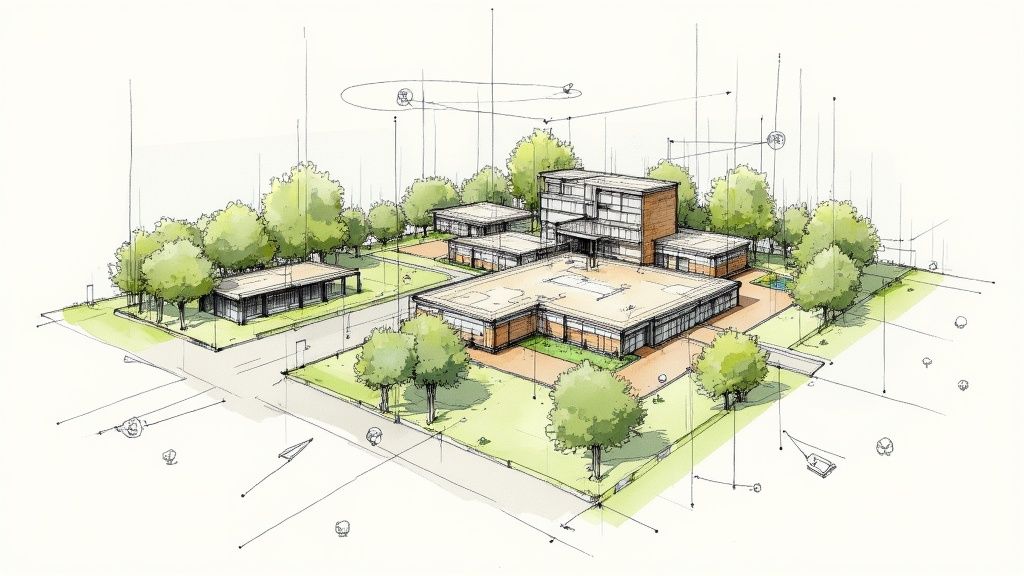
Every great architectural project tells a story, and that story always begins with the land it sits on. Think of your concept sheet not as a static image of a finished idea, but as a visual journey. You're guiding your client from the why of your analysis to the what of your design.
The whole process kicks off with a thorough study of the site. This is more than just measuring boundaries; you're essentially a detective, uncovering all the subtle forces that will influence your building long before you even think about sketching a floor plan.
Turning Raw Data into Insightful Diagrams
Your first job is to document everything you can find, moving from the tangible elements right through to the intangible. This means mapping out the obvious stuff like topography, soil quality, and existing trees, but also capturing the invisible context—the prevailing winds, the path of the sun, the source of neighbourhood noise.
The key is to translate this analysis into clear, compelling diagrams. A huge mistake I often see is just dumping raw data onto the page. Your diagrams need to tell a story about the site's opportunities and constraints. A sun path diagram, for instance, isn't just about showing angles; it's about pinpointing the perfect spot for a sun-drenched breakfast nook or showing why you need shading on the western façade to avoid that brutal afternoon glare.
To see how these early diagrams can evolve into stunning final presentations, check out our guide on creating a /blog/site-plan-rendering.
Getting this right isn't just good design practice; it has tangible benefits. Citing regulatory impacts, data from India's Ministry of Housing and Urban Affairs (MoHUA) in 2023 showed that well-documented concept sheets led to a 32% faster processing of building permissions in Smart Cities Mission projects.
Under the National Building Code (NBC) 2016, a massive 88% of these sheets included critical legal info like easements and Floor Area Ratio (FAR). They also captured sensory analyses, noting that views from 55% of sites in the Delhi NCR were obstructed by pollution—a crucial factor for design.
The real goal of site analysis isn't just to make a list of facts. It’s to find that 'a-ha' moment—the one core insight that drives the entire design. That's the seed from which your project's whole story will grow.
Defining Your Core Design Intent
Once you've got a solid analysis under your belt, it's time to form your 'big idea'—your design intent. This is the central thesis for your project, a clear, concise statement that responds directly to everything you've discovered. It's the glue that holds your entire concept sheet together, ensuring every sketch and diagram supports one unified narrative.
Your design intent should be a direct answer to the challenges and opportunities your analysis uncovered. For example:
-
Is the site plagued by traffic noise? Your intent might be to create a "serene, introverted courtyard building that turns its back on the street."
-
Does the site have a breathtaking view to the west? The intent could be "a structure that frames and celebrates the western vista from every key space."
As you develop your design intent, weaving in concepts like eco-friendly construction principles can make your narrative incredibly compelling. It shows you're not just thinking about the immediate site but also about the project's broader environmental impact.
Ultimately, a strong architectural concept sheet should read like a logical argument. It starts with the reality of the site, moves to your interpretation of that reality, and culminates in a design that feels both wonderfully creative and completely inevitable.
Mastering Layout and Composition for Maximum Impact
A brilliant architectural concept can easily fall flat if the presentation is a mess. How you lay out the elements on your concept sheet is every bit as important as the ideas themselves. A strong composition guides your client’s eye, tells a clear story, and makes your design intent feel both professional and compelling.
It all boils down to creating a clear visual hierarchy. This just means you're intentionally making certain elements pop more than others to control the story you're telling. Your main hero image or a crucial diagram should be the first thing people see—it's the anchor for the whole page. Everything else should flow logically from there, taking the viewer on a journey from the big picture down to the important details.
Structuring Your Visual Narrative
Think of your sheet like a well-designed room. Every piece has its place and purpose. Using a grid system is probably the most reliable way to bring a sense of order to the chaos. Grids create an invisible structure that keeps everything aligned and balanced, giving your presentation that clean, intentional feel that clients love.
That said, if you're working on something more expressive or artistic, breaking the grid with an asymmetrical layout can be incredibly powerful. This approach creates a real sense of energy and movement, but it takes a good eye to pull it off without it just looking sloppy.
The goal isn't just to cram everything onto the page. You're trying to create a visual rhythm. Don't be afraid of white space—it's your best friend for giving your content room to breathe and directing focus where it matters most.
Balancing Images, Text, and Graphics
One of the biggest mistakes I see is designers overloading their sheets. It becomes a dense, intimidating wall of text and images that no one wants to read. You’ve got to find that sweet spot, a harmony between all the different parts.
-
Images and Renders: These are your heavy hitters. They convey form, space, and atmosphere far better than words ever could. Always use high-quality sketches, diagrams, and renders.
-
Text and Annotations: Keep your text short and sweet. Use annotations to highlight key features or explain a specific design choice, not to write a novel. Stick to one or two clean, legible fonts to keep it looking sharp.
-
Colour Palette: Your colour scheme should echo the mood of the project. Pulling colours directly from your material samples or mood board is a great way to tie the whole presentation together visually.
When you're building this narrative, it's also crucial to show the thinking behind your choices. For example, explaining your design decisions for maximizing natural light isn't just a technical point; it shows you've thought deeply about the quality of the space. Weaving these insights into your sheet reinforces the intelligence behind your design.
While these principles apply to any concept sheet, seeing them in different contexts can spark new ideas. For a more focused look at how these layout strategies work for interior spaces, you might find our guide on the interior design concept sheet useful. Get the layout right, and your architectural concept will communicate with clarity and undeniable impact.
Modern Tools and Workflows for Concept Creation
Putting together a powerful architectural concept sheet today is less about hand-sketching and more about smart, digital storytelling. It's a dance between technical precision and compelling visuals. Your workflow will likely start in the familiar territory of AutoCAD or Revit, where you'll nail down the accurate plans, sections, and elevations—the bones of your design.
Once you have that solid technical base, the real artistry begins. You'll export those drawings and bring them into a graphic design environment. This is where tools like Adobe InDesign or Illustrator come into play. It's in this space that you stop being just a drafter and become a storyteller, carefully composing your diagrams, text, and images to create a narrative that guides the viewer’s eye and sells your vision.
Bringing Concepts to Life with Photorealistic Renders
One of the biggest shifts in recent years has been the rise of fast, photorealistic rendering. It's no longer a niche skill. Tools like Lumion, D5 Render, or even newer AI-driven platforms like Vibe3D have become essential. They let you create images that scream atmosphere, light, and materiality in a way that flat line drawings just can't. A single, well-crafted render can communicate the entire mood of a project in an instant.
This tech means you can take a 3D model from SketchUp or Revit and turn it into a beautiful, client-ready visual in a matter of minutes, not days. If the idea is still at sketch or linework stage, a sketch-to-render workflow can help turn that early drawing into a realistic visual before a detailed rendering setup exists. If you want to get a handle on this, a good first step is to explore the different types of architectural rendering software out there to see what fits your process best.
Think of your layout as a simple, logical flow.
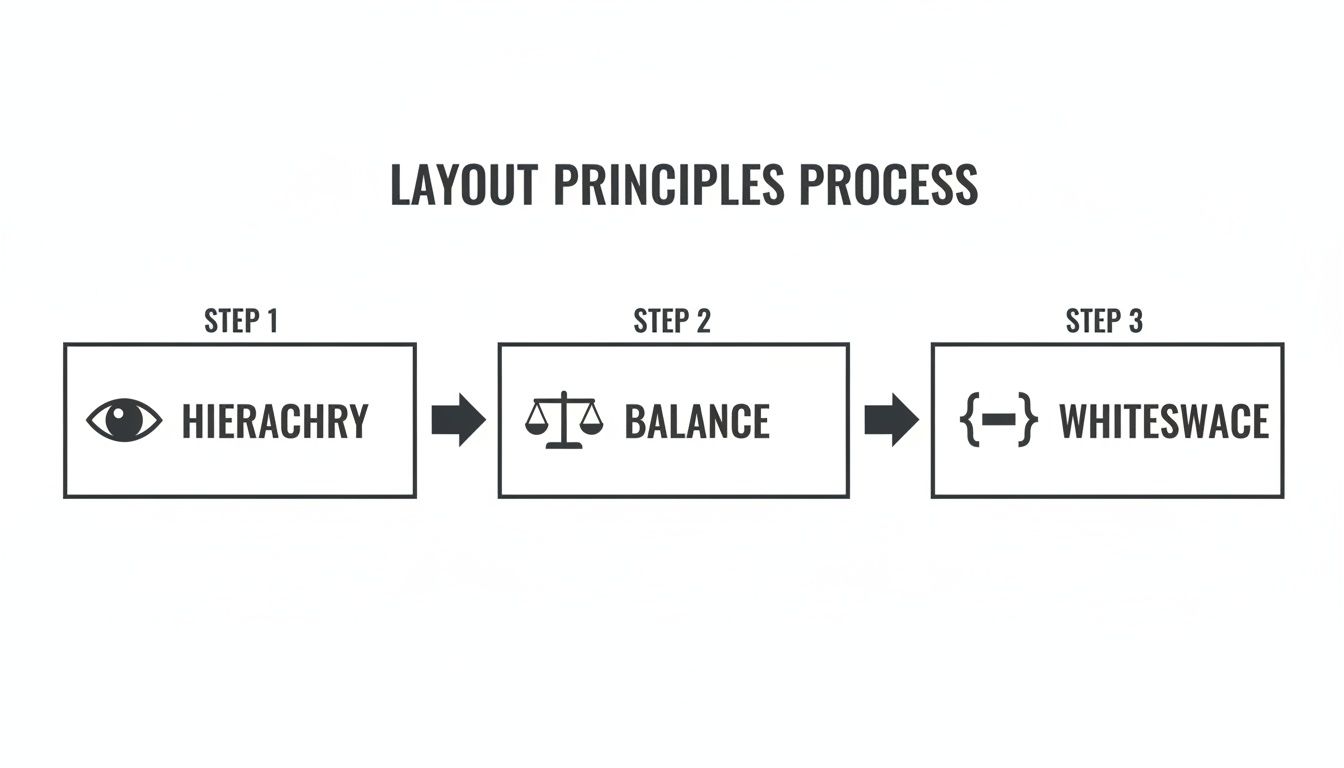
This process—starting with a clear hierarchy, finding visual balance, and using whitespace to let things breathe—ensures every element on your sheet has a purpose.
The Digital Shift in Indian Architecture
This move towards digital tools isn't just happening globally; it’s profoundly changing how architecture is practised and taught right here in India. In many universities, the concept sheet now accounts for a hefty 30% of the evaluation criteria for a final thesis.
The numbers tell the story. Data from the Indian Institute of Architects (IIA) shows that since 2020, there’s been a 45% jump in the use of digital tools like BIM specifically for creating concept sheets. This is making a huge difference in renovation projects, where better digital documentation has cut down errors by 40%. That's a massive deal when you consider India's retrofit market is a sprawling 70 million sq.m annually.
A modern workflow isn't just about having the latest software. It's about building a smooth pipeline—one where your technical drawings, evocative renders, and clean graphic design all work together to tell a single, powerful story. The real goal is to make a complex idea feel simple, and your vision feel completely inevitable.
Frequently Asked Questions About Concept Sheets
Even those of us who have been in the game for years still have questions when putting together a concept sheet. Let’s walk through some of the most frequent ones I hear to help you sharpen your approach and present your ideas with more confidence.
What’s the Right Level of Detail?
This is the big one. The golden rule is to keep it conceptual. You have to actively fight the temptation to cram in technical construction notes, precise dimensions, or detailed specs. That's not what this stage is about. The whole point is to communicate the core idea, not the nuts and bolts of how it will be built.
Instead, concentrate on showing:
-
The big picture of the spatial organisation and how people will move through it.
-
The building's general form, its massing, and how it sits on the site.
-
The kind of atmosphere and feeling you're aiming for with the materials.
Lean on expressive diagrams, evocative sketches, and mood imagery—not technical drawings. You're selling the 'why' and the 'what' of your design, not the granular 'how'. Getting this distinction right is probably the most important part of creating a successful concept sheet.
I always tell junior architects to think of the concept sheet as the movie trailer, not the full film. Your job is to generate excitement and get everyone on board with the central theme, not to spoil every single scene.
How Do Concept Sheets Change for a Renovation?
When you’re working on a renovation, the existing building isn't just background context—it’s the main character in the story. This means your concept sheet absolutely has to feature the 'before' state prominently. You'll need good photos of the existing structure, clear drawings of what's already there, and a concise analysis of what you plan to keep, adapt, or demolish.
The whole narrative flips. Instead of creating something from a blank slate, you’re crafting a thoughtful intervention. Your design story should be all about how your proposal responds to the existing fabric, solves its inherent problems, and elevates its best features. For a new build, the story is about responding to an empty site; for a renovation, it's a dialogue with an existing structure.
Should I Make a Digital or Physical Concept Sheet?
Honestly, the answer is both. A large-format printed sheet—usually A1 or A0—is still the best choice for big, formal client meetings. There's just something about a tangible, physical board that commands attention and makes an impression in a room.
That said, a digital version is non-negotiable. A high-resolution PDF is essential for sharing with team members or clients who are remote, attaching to email updates, or presenting on a screen during a video call. The design principles are the same for both, but you should always create your layout with both formats in mind. This ensures everything looks sharp and is easy to read, whether it’s hanging on a wall or being viewed on a laptop.
Ready to bring your concepts to life faster than ever? Vibe3D uses AI to turn your models into stunning, photorealistic visuals in seconds, perfect for elevating your next concept sheet. Cut down your rendering time and present your ideas with the clarity and impact they deserve. Explore AI 3D rendering on Vibe3D today.