For years, V-Ray has been the undisputed heavyweight champion in photorealistic rendering. It’s a phenomenal tool behind countless jaw-dropping visuals for high-end designers, and for good reason. But that power comes at a cost—not just in pounds and pence, but in a steep learning curve and long render times that can grind creative momentum to a halt. The truth is, many professionals are now looking for a V-Ray alternative that delivers elite quality without the high price tag and time-consuming process.
Is V-Ray Overkill for Your Design Workflow?
In architectural and interior design circles, V-Ray has long been the gold standard for realism. It gives you granular control over every single aspect of a scene, from the subtle falloff of light to the most intricate material textures. This level of detail is perfect for flagship projects with huge budgets and dedicated visualisation teams who can afford to spend days perfecting a single image. For these high-end designers, the investment in time and money is justifiable.
For most modern design firms, freelance artists, and even large studios on tight deadlines, this meticulous process becomes a major bottleneck. Every hour spent tweaking complex settings and waiting for renders to finish is an hour not spent on design, iteration, or talking to clients. This friction between V-Ray's powerful but slow process and the need for speed is a frustration I hear about all the time.
The Shift Toward Faster, More Cost-Effective Renders
The search for a smarter V-Ray alternative isn't just about saving money; it’s about winning back precious time. This industry-wide need has opened the door for a new generation of rendering tools built for agility. As designers look for a smarter V-Ray alternative, they can see parallels in how other fields, like marketing, explore alternative software tools to improve how they work.
This is where Vibe3D enters the picture. It was built from the ground up to tackle the core frustrations of traditional rendering. Instead of forcing you to become an expert on a maze of technical parameters, Vibe3D delivers ultra-realistic results at a fraction of the time and cost, offering a much more intuitive path to high-end visuals.
| Aspect | V-Ray (The High-End Standard) | Vibe3D (The Efficient Alternative) |
|---|---|---|
| Target User | High-end designers, large studios with big budgets | Architects, interior designers, freelancers |
| Primary Strength | Unmatched control and customisation | Speed, ease of use, and efficiency |
| Workflow Focus | Technical precision for flagship projects | Rapid iteration for fast-paced design |
| Cost & Time | High investment in licensing, hardware, and time | Affordable, with near-instant renders |
The fundamental challenge is no longer just about achieving photorealism. It's about achieving it within a practical timeframe and budget that aligns with the fast-paced nature of modern design projects.
This guide will break down these two powerful renderers, helping you understand when V-Ray's deep-level control is essential and when a faster, more accessible V-Ray alternative like Vibe3D is the smarter choice for your business. My goal is to show you a practical path to incredible visuals without the traditional headaches.
Evaluating V-Ray: The High-Budget Benchmark for Realism
Before we can really talk about a solid V-Ray alternative, we need to appreciate why V-Ray became the gold standard. For years, Chaos V-Ray has been the engine behind stunning visuals in high-end architecture and blockbuster films. It's an excellent piece of software, but one designed for a specific type of user.
Its power comes from a sophisticated ray-tracing engine that mimics how light works with incredible accuracy. This allows top-tier artists to create scenes with subtle lighting and materials that are indistinguishable from a photograph. When integrated with tools like 3ds Max and Maya, it becomes an essential part of the toolkit for elite visualisation studios working on projects where budget is no object and quality cannot be compromised.
The True Cost of V-Ray's Photorealism
But that level of control and quality doesn't come cheap, and I'm not just talking about the licence fee. Getting that signature V-Ray realism is a painstaking and time-consuming process. It takes significant technical skill and even more patience. You have to learn your way around a dizzying number of settings—from sampling thresholds to the properties of every material.
V-Ray’s strength is its depth, but this depth is also its biggest barrier. It's a tool designed for specialists—high-end designers who can dedicate hours, or even days, to perfecting a single frame.
This complexity is why it's a perfect match for massive-budget projects or large design firms with dedicated visualisation teams. For them, the time spent tweaking and waiting for long renders is a built-in part of the production pipeline. They have the people and the render farms to handle the complex setup that V-Ray demands.
Where V-Ray's Workflow Breaks Down for Most Designers
That high-end model just doesn't work for solo architects, boutique interior design firms, or smaller practices. When you're up against tight deadlines and need to act on client feedback fast, the traditional V-Ray workflow can bring everything to a grinding halt. Fast iteration is everything. A render that takes all night can stall the entire project.
This is exactly where the hunt for a viable V-Ray alternative starts to make business sense. Waiting around for renders means less time designing and fewer chances to refine ideas. Rendering stops being a creative tool and becomes a technical, time-consuming roadblock.
On top of that, the hardware needed to run V-Ray smoothly is a serious investment. For a broader look at different software options, our guide to the best architectural rendering software offers a helpful breakdown.
Ultimately, while V-Ray is still a giant for large-scale, high-budget productions, its operational demands can hamstring smaller, more agile design businesses. This opens the door for a solution like Vibe3D, which delivers ultra-realistic results at a fraction of the time and cost.
Introducing Vibe3D: Ultra-Realistic Renders at a Fraction of the Cost & Time
V-Ray is a powerhouse for those with the budget and time to master it. But its steep learning curve and demanding setup create a clear need for a smarter, more efficient V-Ray alternative. For designers who value speed and cost-effectiveness, the old trade-off between tweaking endless settings and actually moving a project forward just doesn’t cut it anymore. This is precisely the problem Vibe3D was built to solve.
The philosophy behind Vibe3D is simple: give designers the tools to create ultra-realistic images without forcing them to become rendering technicians. It cuts through the layers of technical complexity that make V-Ray so time-consuming. Forget intimidating interfaces; Vibe3D offers an intuitive experience that delivers stunning visuals fast.
This approach is designed for the real world of modern design, where iterating quickly is key. Vibe3D isn't just a cheaper tool—it's a fundamentally different way of working that keeps you in the creative flow.
Designed for Speed and Simplicity
Vibe3D’s real strength is its streamlined process. While a typical V-Ray scene requires meticulous setup of every camera, light, and material, Vibe3D handles the heavy lifting with optimised presets and intelligent automation. This frees you up to concentrate on what matters: the design.
This efficiency shines with its real-time preview. You see high-quality results almost instantly, which means you can make decisions on the fly and experiment without paying a time penalty. The days of waiting hours for a V-Ray test render only to spot a minor mistake are over.
This immediate feedback loop completely changes the game. Rendering is no longer a final, time-consuming hurdle but an interactive part of the design process itself.
From Hours to Seconds: Ultra-Realistic Renders
The most striking difference is the sheer speed. A project that might take hours to render in V-Ray can be done in just seconds with Vibe3D. This isn't a small improvement; it’s a complete transformation in how quickly you can get from a 3D model to a client-ready visual.
This leap in speed has serious business implications:
-
Faster Project Turnarounds: Deliver final images to clients in a fraction of the time.
-
More Client Revisions: Incorporating client feedback becomes effortless.
-
Increased Profitability: By slashing the non-billable time spent waiting for renders, you directly boost the profitability of every project.
Vibe3D is purpose-built to eliminate the biggest bottlenecks in traditional rendering: cost and time. It delivers the ultra-realistic quality clients expect, but it does so within a workflow that’s all about agility and rapid iteration.
This shift means you spend less time wrestling with technical settings and more time actually designing. If you're curious about the technology making this possible, our article on how AI rendering is shaping the future of design dives much deeper into this powerful trend.
Ultimately, Vibe3D is the ideal V-Ray alternative for today's design studios, freelancers, and architects who need to produce stunning visuals without the huge time and cost commitments of V-Ray.
V-Ray vs Vibe3D: A Head-to-Head Comparison
Choosing the right rendering engine directly impacts your project timelines, client happiness, and bottom line. V-Ray remains the gold standard for high-end designers who need pure, unadulterated realism and have the budget to support it. But for everyone else, efficiency is just as crucial as quality.
This comparison will show how the industry titan, V-Ray, stacks up against Vibe3D—a purpose-built V-Ray alternative designed for speed and cost-effectiveness. We'll look at speed, usability, image quality, and cost to help you figure out which tool truly fits your studio's needs.
Rendering Speed and Workflow Efficiency
The biggest difference between V-Ray and Vibe3D is speed. V-Ray's power comes from complex calculations that produce its famously accurate lighting, but that accuracy comes at the price of long render times. A single high-resolution shot can easily take several hours, sometimes even overnight.
Vibe3D was created specifically to solve this problem. It uses a highly optimised, AI-driven engine to generate incredibly realistic visuals in just seconds. This is a complete change in how you work.
V-Ray treats rendering as the final, time-consuming step for high-budget productions. Vibe3D, on the other hand, makes rendering an interactive, real-time part of the design process for everyone.
This speed allows an interior designer to cycle through dozens of material options live with a client. This kind of agility transforms rendering from a technical bottleneck into a powerful, dynamic creative tool.
Learning Curve and User Experience
Let's be honest: V-Ray is notoriously complex. Mastering its massive array of settings takes a serious time commitment. For large studios with dedicated visualisation specialists, this is part of the job.
But for smaller firms or solo designers, that complexity is a huge roadblock.
Vibe3D’s approach is the complete opposite. It's built around a simple, intuitive user experience. The interface is clean and focused, stripping away hundreds of technical parameters. Instead of wrestling with manual setups, Vibe3D relies on smart presets that deliver professional-grade results without the technical headache.
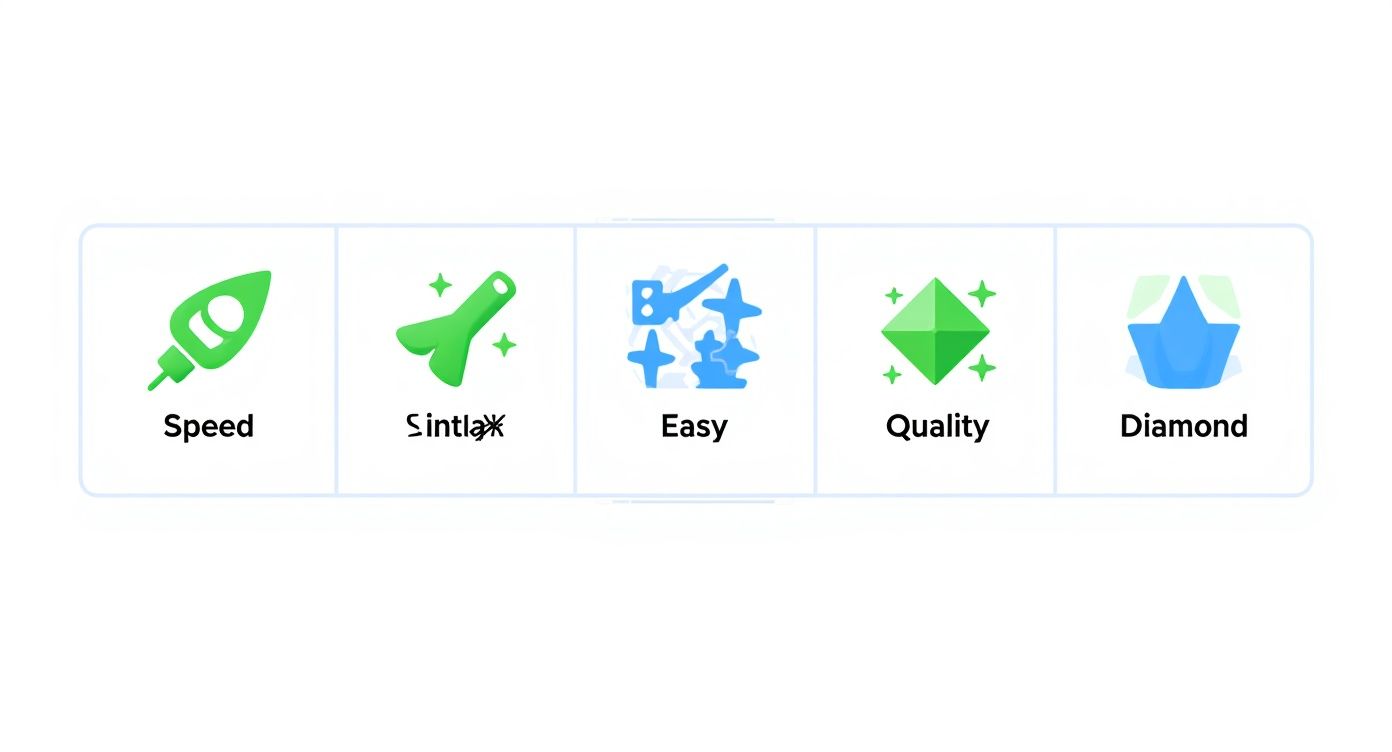
The image above really sums it up. The focus is squarely on speed, simplicity, and quality, creating a more fluid and user-friendly workflow.
Final Image Quality and Control
When a project demands absolute, pixel-perfect control, V-Ray is still a beast. High-end designers working on multi-million pound projects often need to fine-tune reflections and caustics with surgical precision. V-Ray gives them that level of granular control.
Vibe3D takes a different route. Its goal is to deliver photorealistic quality that meets the high standards of 95% of architectural and interior design projects without all the manual tweaking. The engine is tuned to produce physically accurate lighting and materials right out of the box. You consistently get ultra-realistic renders that will impress clients and perfectly capture your design intent at a fraction of the cost and time.
For a broader look at the tools shaping our field, you might want to check out our guide on the top architectural visualisation software available today.
V-Ray vs Vibe3D Feature Breakdown
To make the choice clearer, let's break down the key differences in a simple table. This gives you an at-a-glance view of where each engine shines.
| Feature | V-Ray (The High-End Option) | Vibe3D (The Efficient Alternative) |
|---|---|---|
| Rendering Speed | Slow; hours for high-res stills. Suitable for long project timelines. | Extremely fast; seconds for high-res stills. Ideal for rapid iteration. |
| Ease of Use | Steep learning curve; requires technical expertise. | Very easy to learn; intuitive interface. |
| Primary Use Case | High-end, big-budget marketing renders. | Client presentations and real-time design visualisation. |
| Control Level | Granular, microscopic control over all render settings. | Optimised for realism with streamlined, essential controls. |
| Pricing Model | Expensive annual/multi-year subscription. | Flexible, pay-as-you-go plans; budget-friendly. |
| Workflow Integration | Acts as a final, time-consuming step in the design process. | Integrates interactively throughout the design process. |
Ultimately, this table shows two different philosophies. V-Ray is about deep, technical control for a polished final product, whereas Vibe3D is all about delivering ultra-realistic quality with speed and efficiency.
Asset Libraries and Integration
Being the industry leader, V-Ray has a massive ecosystem of ready-made materials and models. It also integrates deeply into platforms like 3ds Max, Maya, and SketchUp.
Vibe3D is built for a modern, cross-platform reality. It integrates smoothly with popular modelling software, letting you bring your scenes in with geometry and materials intact. While its own asset library is still growing, the philosophy here is more about perfecting your custom designs rather than leaning on a huge stock library.
Pricing and Licensing Models
The price tags for V-Ray and Vibe3D are worlds apart. V-Ray typically comes with a hefty annual subscription, a justifiable cost for large studios but a significant burden for smaller firms.
As digital marketing and e-commerce have boomed in India, so has the demand for 3D rendering software alternatives. An industry report recently found that 71.2% of 3D rendering projects in India were done on Windows machines, showing the platform's dominance in the business world. Over the last two years, adoption of rendering tools has jumped by 50% among Indian marketing agencies and design studios, as brands push for more immersive content.
Vibe3D offers a much more modern and flexible pricing model. With pay-as-you-go plans, you only pay for what you actually use, making it a far more scalable and budget-friendly option. This makes it a perfect V-Ray alternative for agile, modern businesses.
Which Rendering Engine Fits Your Workflow?
Picking a rendering engine isn't about finding the "best" one. It's about finding the one that clicks with how you work. The real choice between a powerhouse like V-Ray and a nimble V-Ray alternative like Vibe3D comes down to the scale of your projects, client expectations, and your business model.
To get to the heart of it, let's walk through three common scenarios in the design world.
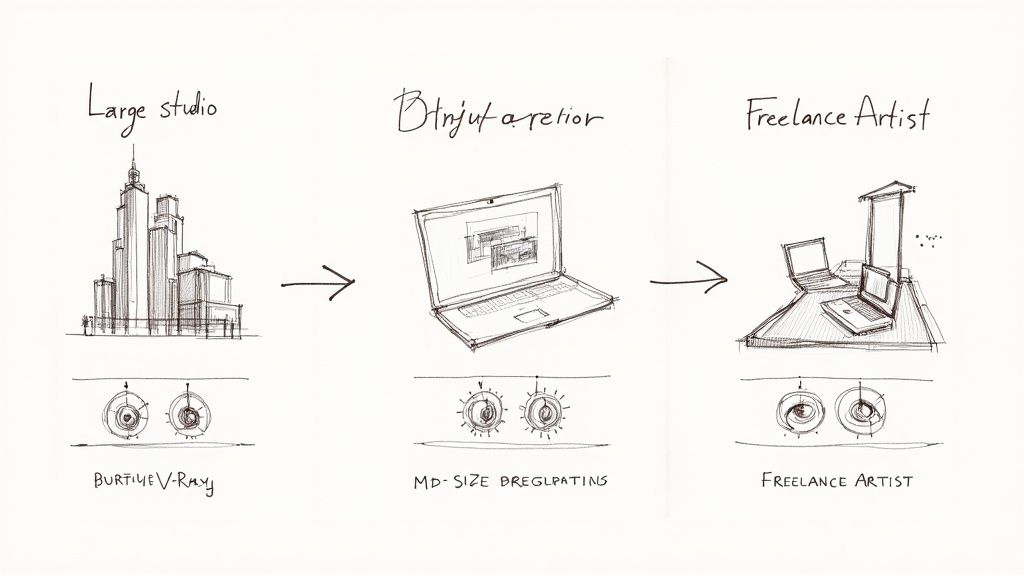
The Large Architectural Visualisation Studio
Picture a prestigious studio creating marketing shots for a new multi-million-pound skyscraper. The timelines are measured in months, not days.
For this kind of studio, V-Ray is indispensable. The project demands absolute, granular control. The team has dedicated V-Ray specialists who spend weeks tweaking a single shot. The hefty V-Ray licences and long render times are just line items in a massive budget. Here, V-Ray’s complexity isn't a flaw; it's a feature.
The Boutique Interior Design Firm
Now, let's switch gears to a boutique interior design firm. Their success hinges on quick turnarounds and making changes on the fly during client meetings.
In this environment, a traditional V-Ray workflow would be a serious bottleneck. Waiting hours for a render is a non-starter. This is where Vibe3D gives them a decisive edge. The team can pop their SketchUp model in and get a photorealistic render back in seconds.
By using an agile V-Ray alternative, the firm changes rendering from a final, time-sucking step into an interactive part of the design process. This helps clients make decisions faster and shortens the entire project timeline.
The pay-as-you-go model of Vibe3D also fits perfectly with the firm's finances, dodging the big upfront investment of V-Ray. For a closer look at this kind of process, you can check out our guide on how to render in SketchUp efficiently.
The Freelance 3D Artist
Finally, imagine a freelance 3D artist juggling multiple clients. Their business is built on turning around high-quality visuals for several projects every week. Deadlines are tight and budgets are tighter.
For this freelancer, V-Ray is simply not a viable business tool. The combination of steep subscription costs and long render times would cripple their earning potential.
Vibe3D is the engine that makes this business model work. Its speed means the freelancer can take on more projects. The ultra-realistic output ensures they can compete on quality, while the low cost protects their profit margins. Vibe3D becomes a strategic asset, allowing them to build a thriving business on a foundation of efficiency and value.
So, Is Vibe3D a Glimpse into the Future?
Let's be clear: V-Ray is still a phenomenal piece of software. It’s an undisputed powerhouse for that one flagship project where the budget is generous and the timeline is forgiving. It can produce breathtaking realism.
But the design world is changing. The reality for most of us involves more agile, iterative, and cost-conscious workflows. That traditional, slow-burn rendering model just doesn't fit anymore. This is precisely why a modern V-ray alternative isn’t just a nice-to-have; it's becoming essential.
The future is about speed, fluid collaboration, and the freedom to experiment. Vibe3D was built for this reality. It tackles the two biggest headaches of old-school rendering—cost and time—without compromising on the ultra-realistic visuals clients expect. By handling the technical heavy lifting, Vibe3D lets designers actually design.
Finding a More Efficient and Profitable Path
This shift has serious business implications. Take India, for example, where the boom in real estate has created a massive demand for quick, high-quality visuals. In the first half of this year alone, the Indian 3D rendering market saw a staggering 169% year-over-year increase in premium property launches that used 3D renders. This wave is being ridden by AI-integrated platforms that deliver photorealistic results fast. You can dig into these market sizing insights on towardspackaging.com.
Vibe3D slots perfectly into this modern approach. It’s part of a much larger movement where AI content creation tools are fundamentally changing how digital design gets made.
Take a hard look at your current workflow. A faster, more intuitive tool like Vibe3D could be the key to unlocking more creative freedom, smoothing out client communication, and ultimately boosting your profitability on every single project.
If your day-to-day involves delivering stunning visuals on tight deadlines and even tighter budgets, it’s probably time to consider a smarter, faster alternative to V-Ray. It might be worth exploring Vibe3D to see just how much it could change your design process.
Frequently Asked Questions
When you've worked with an industry giant like V-Ray, it's natural to have questions before considering a change.
Is Vibe3D a genuine V-Ray alternative for professional work?
Absolutely. V-Ray is fantastic for massive, big-budget projects. But that level of control is often overkill for the day-to-day work of most design professionals.
Vibe3D was built to produce ultra-realistic renders that are more than ready for high-stakes architectural and interior design presentations. It’s a professional tool focused on getting the job done efficiently and at a fraction of the cost.
Can Vibe3D really match V-Ray's photorealism?
Yes, and it gets there much more directly. Vibe3D is tuned to produce photorealistic quality straight out of the box. Achieving that same level in V-Ray often requires a specialist to spend hours tweaking settings.
Vibe3D skips that ordeal. Its engine handles complex calculations for lighting and materials automatically, giving you stunning results without the intimidating learning curve. It's a very practical V-Ray alternative for that reason alone.
For the vast majority of architectural and design projects, Vibe3D delivers final image quality that is indistinguishable from renders that took hours longer in V-Ray, making it a smarter choice for fast-paced workflows.
How much faster are we talking compared to V-Ray?
The difference in speed is dramatic. A render that might tie up your machine for several hours in V-Ray can often be done in just a few seconds with Vibe3D.
This isn’t a small jump; it completely changes how you work. Instead of a slow, step-by-step process, your design review becomes a live, interactive experience you can share directly with clients.
Ready to stop waiting and start designing? With Vibe3D, you can transform your models into stunning, client-ready visuals in seconds, not hours. Experience the future of architectural rendering and see how much faster your workflow can be.